Elephes Sung

Something of a scientist
Version v0.1.5
Updated
Author King of the Clingenland License MIT

About

Elephes Sung
print(“hello”)

I am currently a PhD student in Life Sciences at Imperial College, with a research interest in mathematical biophysics and immunology.

Previously, I completed an MRes in Systems and Synthetic Biology, also at Imperial College. Even prior to that, I got my bachelor’s degree in Nanomaterials and Nanotechnology.

Approximately 84% of people mispronounce my name on first reading, while 52.1% confidently assume it is Greek. Neither observation is especially concerning: you are entirely welcome to pronounce it however you wish.

You can email me at eu23@ic.ac.uk


Trajectory

This is a horizontal plot, scroll right to check it.

/*
            I need more quantitative                                                                                  
            & systematic methods to                                                                                   
            immunological mechanisms                                                                                  
                     │                                                                                                
  2019-2023          │       2023-2024                               2024-2028                                        
 ┌───────────────┐   │      ┌────────────────────┐                  ┌─────────────────────────────────────────┐       
 │ B.Eng.        ┼───┴─────►│ M.Res. Systems     ┼──────┬──────────►│ PhD in Life Sciences Research           │       
 │ Nanomaterials │          │ & Synthetic Biology│      │           │ President's Scholarship                 │       
 └┬──┬──────────┬┘          └─────────┬──────────┘      │           └──────┬──────────────────────────────────┘       
  │  └─────┬────┘                     │             in between:            │   Project 1. dynamics of interactions    
  │        │~3yrs                     │             ESA Hackthon           │          between killer immune cell      
  │        ▼                          ▼             Bayesian inference     │                     & target cells       
  │   UG project               Master's project       for astronauts'      │                                          
  │   Injectable Hydrogel      Agent-based modelling    health prediction  │   Project 2. dynamics of immune receptors
  │   NK cell delivery         NK cell-tumour                              │          & cell decision-making          
  │         cancer therapy             interactions                        │                                          
  ▼ ~1yr                                                                   │                                          
  lab intern                                                               small confidential project:                
  solar chemical                                                           Google Deepmind & Imperial College         
  battery                                                                                                             
┌──────────────────────────────────────────────────────────────────────────────────────────────────────────────┐      
│  TIMELINE                           TIMELINE                        TIMELINE                     TIMELINE    │      
└──────────────────────────────────────────────────────────────────────────────────────────────────────────────┘      
 */


Attempts

I was trained first as an experimentalist and later moved toward theoretical work. Ideally, I hope to combine experiment and theory more closely in the near future. Here are a few things I have done, and a few I am still doing.


Bayesian inference for immunology

Unpublished preliminary work

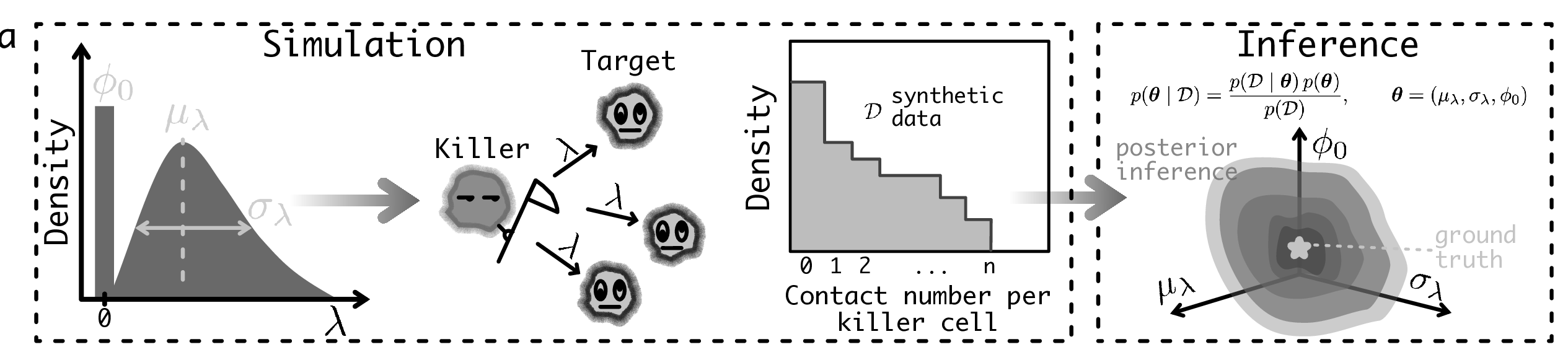
Cropped preliminary figure showing panel a from an unpublished Bayesian framework for cytotoxic lymphocyte-target cell interaction dynamics.
Cropped panel a from an unpublished Bayesian framework for cytotoxic lymphocyte-target cell interaction dynamics. Open PDF
brief introduction (unpublished and confidential)

This is an unpublished and still-confidential project on Bayesian inference for time-lapse imaging data in immunology, focused on cytotoxic lymphocyte-target cell interactions at the single-cell level.

The central aim is to build a mechanistic framework that separates migration, encounter and contact formation, and post-contact killing decisions, so that heterogeneous behaviour can be interpreted in biologically meaningful terms rather than only through endpoint summaries.

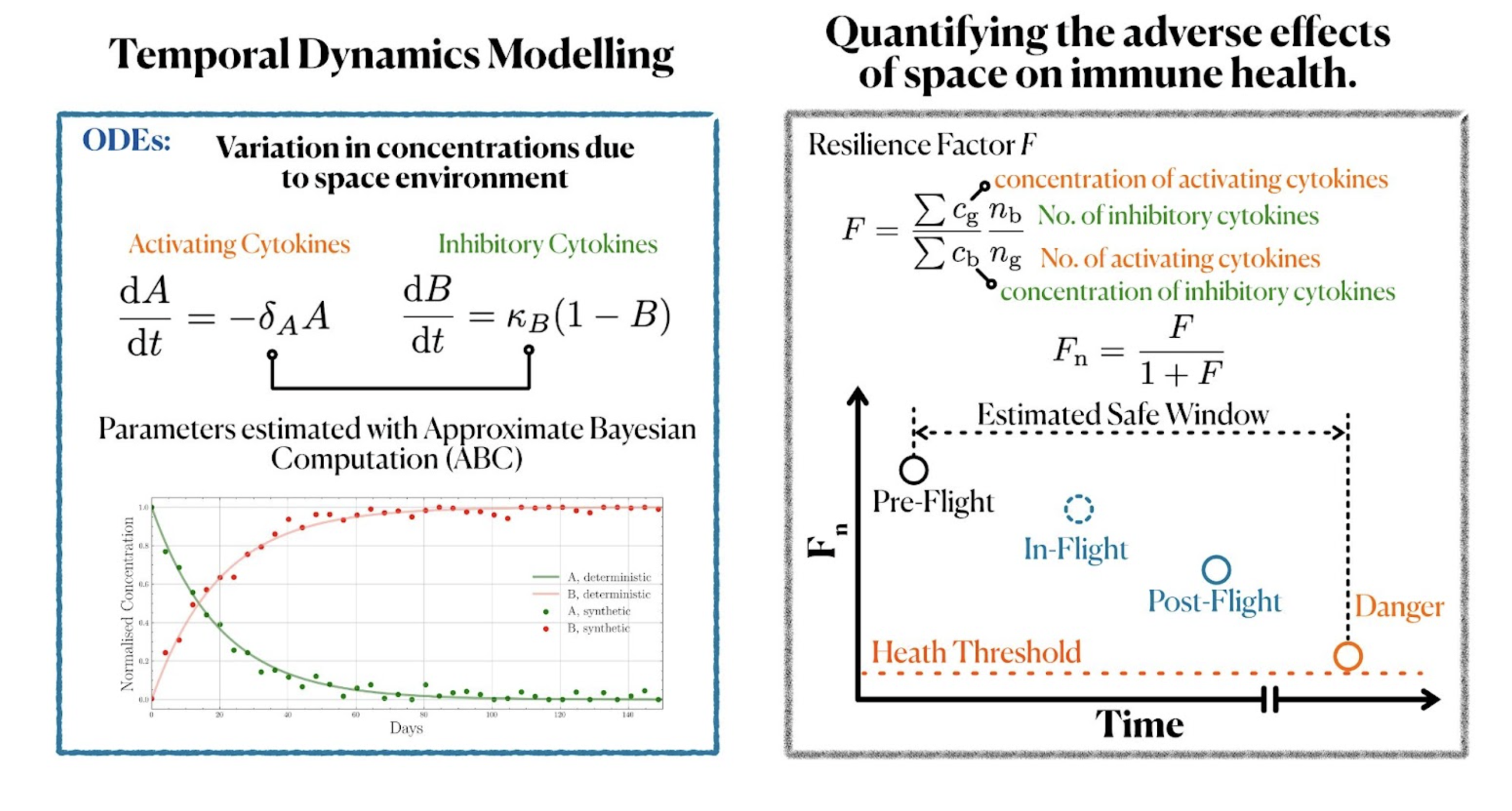
Summary slide from Redshift, a hackathon project modelling astronaut immune health with cytokine dynamics and a normalized resilience factor.
Redshift: a compact cytokine-based immune-risk model for spaceflight.

Redshift

A brief Bayesian/ABC modelling project from the first European Space Agency hackathon, building a compact cytokine-based resilience factor for astronaut immune health.

Our team initially won, though the medal was later rescinded for administrative and political reasons.


Crappy softwares: imaging analysis and simulators

Single-cell dynamics from CytotoxicVision.

CytotoxicVision

A small but useful imaging pipeline for analysing time-lapse fluorescence microscopy data of NK-cell interactions with 721.221 target cells. Demo data from Dr Cathal Hosty from the Dan Davis lab.

The current version is still more of a demonstration framework than a polished package, but it already produces interpretable single-cell and population-level readouts.

Repository: github.com/ElephesSung/CytotoxicVision

Agent-based killer-target simulation from MantiShrimp.

MantiShrimp

A lightweight agent-based simulator for killer-target immune-cell interactions, built to study migration, contact formation, probabilistic killing, and target death dynamics in 2D.

Repository: github.com/ElephesSung/MantiShrimp

Lineage-level visualisation from the zebrafish analysis pipeline.

Confidential software under development

zebrafish

An internal zebrafish time-lapse imaging analysis pipeline for preprocessing 4D microscopy data, generating nuclei masks, tracking cells across time, and performing lineage-level heterochromatin dot detection. Data from May Liu at PDN Cambridge.

Status: private repository, active development.


Injectable Hydrogel

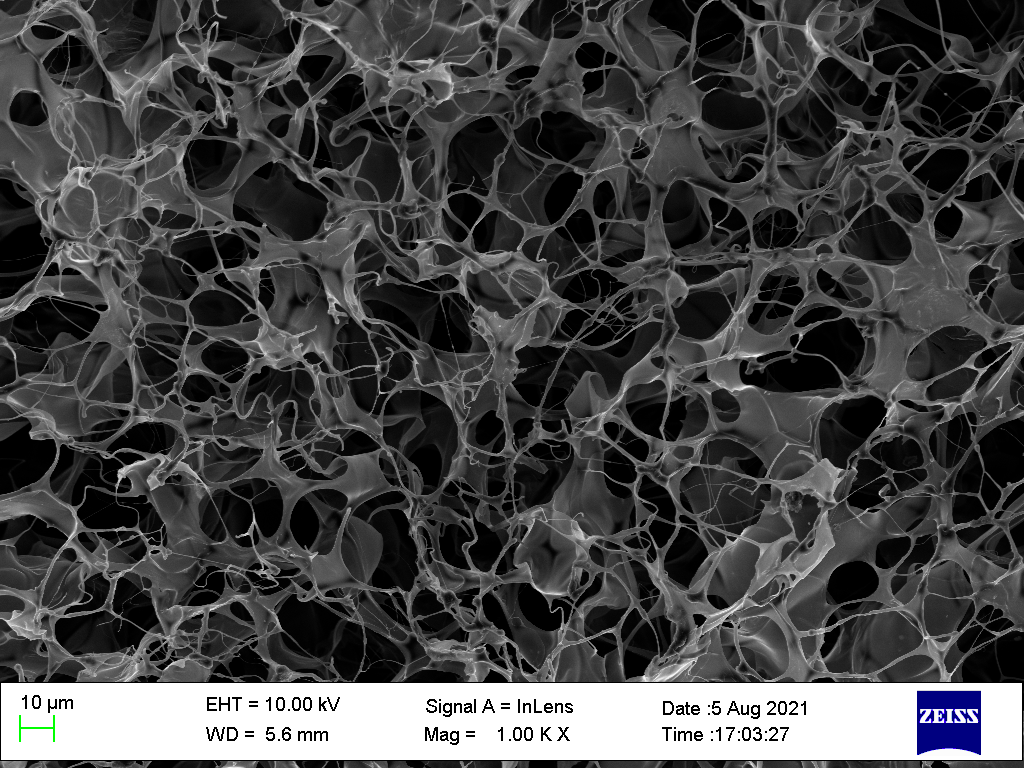
Up: Scanning electron microscopy (SEM) image showing the interconnected porous microstructure of the hydrogel scaffold.

← Injectable shape-memory hydrogel (gelatin) during compression and recovery.

↑ SEM view of the porous scaffold architecture.

porous cryogel

This was a biomaterials project I reproduced during my undergraduate studies, based on the injectable shape-memory scaffold reported by Bencherif and colleagues. The concept was simple but elegant: to create a porous hydrogel that could be compressed, injected through a syringe, and then recover its original structure after injection.

In their work, the porous architecture was generated through slow covalent crosslinking at low temperature. Ice crystals formed during the crosslinking process occupied space within the material and later served as pore templates.

Later, my colleagues and I developed a related approach for producing an ionically crosslinked porous alginate hydrogel. We first froze and lyophilised the alginate precursor, then immersed it in a calcium-ion solution to induce crosslinking. This produced a highly similar porous structure, while also preserving the material’s injectable behaviour.

Our original aim was to load NK cells into the hydrogel and use it as a delivery platform for solid tumours. Because of COVID and a few other unavoidable disruptions, I never managed to complete the bioengineering part of the project. It was a slightly frustrating ending.

Reference: Sidi A. Bencherif, R. Warren Sands, Deen Bhatta, et al. “Injectable preformed scaffolds with shape-memory properties.” Proceedings of the National Academy of Sciences 109(48): 19590-19595 (2012). doi.org/10.1073/pnas.1211516109


Publications

Google Scholar

Mathematical Biophysics

coming soon…

Nanomaterials & Drug Delivery

Review

Precision Medicine: The Road to In Vivo Synthetic Therapeutic Agent.

Yang‐Bao Miao, Zhao Wang, Fan-Xin Song, Renchi Gao, Zheng Deng, Guohui Zhang

Advanced Functional Materials, Vol. 35, Issue 47, p. 2510183 (2025)

Read more

Review

Recent Progress in Nanomaterial-Based Biosensors and Theranostic Nanomedicine for Bladder Cancer.

Fan-Xin Song, Xiaojian Xu, Hengze Ding, Le Yu, Haochen Huang, Jinting Hao, Chenghao Wu, Rui Liang, Shaohua Zhang

Biosensors, Vol. 13, Issue 1, p. 106 (2023)

Read more

Article

Achieving Precise Non-Invasive ROS Spatiotemporal Manipulation for Colon Cancer Immunotherapy.

Yang-Bao Miao, Hong-Xia Ren, Guohui Zhang, Fan-Xin Song, Weixin Liu, Yi Shi

Chemical Engineering Journal, Vol. 481, p. 148520 (2024)

Read more

Article

Tailoring a Luminescent Metal–Organic Framework Precise Inclusion of Pt-Aptamer Nanoparticle for Noninvasive Monitoring Parkinson’s Disease.

Yang-Bao Miao, Hong-Xia Ren, Qilong Zhong, Fan-Xin Song

Chemical Engineering Journal, Vol. 441, p. 136009 (2022)

Read more

Article

All-in-One, Solid-State, Solar-Powered Electrochemical Cell.

Yu Zhao, Chenyang Li, Fan-Xin Song, Yi Li, Yan Liu, Yajie Zhao, Xiaohong Zhang, Yu Zhao, Zhenhui Kang

ACS Applied Materials & Interfaces, Vol. 12, Issue 51, pp. 57182–57189 (2020)

Read more